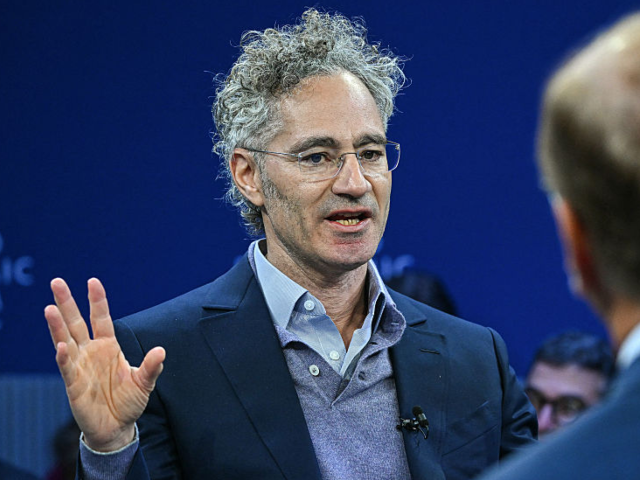
There is little need for large-scale migration into U.S. jobs while Americans’ productivity is being turbocharged by artificial intelligence, according to Alex Karp, CEO of the fast-growing Palantir Technologies.
“I do think these trends really do make it hard to imagine why we should have large-scale immigration unless you have a very specialized skill,” Karp told an elite audience at the 2026 World Economic Forum meeting in Davos, Switzerland.
The technology will replace many white-collar jobs, he said, adding, “There will be more than enough jobs for the citizens of your nation, especially those with vocational training.”
The statement is good news for the millions of American college graduates who have been pushed out of careers and prosperity by a huge inflow of mostly Indian H-1B visa workers. The imported visa workforce has been used to sideline outspoken American professionals and to create a backroom economy of kickbacks that enriches U.S. and Indian managers, chokes innovation, and defrauds stockholders.
Clever people will prosper even as the AI technology performs more white-collar tasks, Karp said:
The person managing our Maven [intelligence] system in the U.S. Army is a former police officer who I think, went to a junior college. They’re doing very, very high-end, very complicated targeting globally, and that person actually is irreplaceable. I think in the past, the way we tested for aptitude would not have fully exposed how irreplaceable that person’s talents are — and would [that person] have been as talented if they had not gone to their college?
Overall, the AI technology will help well-managed communities, he said. “America and China… work at scale, and I think that is very likely to accelerate way beyond what most people believe is possible,” said Karp. Worldwide, he said, “I would imagine… you’re just going to find pockets that go very well and pockets that go very poorly.”
President Donald Trump echoes the technology-beats-migration theme in some of his speeches as he zig-zags between his business allies and his populist base. For example, in his January 21 speech at the Davos conference, he said:
Our previously open and dangerous border is closed and virtually impenetrable, and the United States is in the midst of the fastest and most dramatic economic turnaround in our country’s history. Under the Biden administration, America was plagued by the nightmare of stagflation, meaning low growth and high inflation, a recipe for misery, failure, and decline. But now, after just one year of my policies, we’re witnessing these opposite — virtually no inflation at extraordinarily high economic growth.
Many tech leaders say the fast-evolving AI technology will sweep away many traditional jobs in software, media, and other sectors. This technological revolution is allowing tech-sector CEOs to speak out against mass migration.
For example, Elon Musk has also escalated his criticism of mass unskilled migration:
“We cannot let [illegal migrants] stay… [because] democracy is the real issue,” said Palmer Lucky, the founder of Anduril Industries, a defense company:
There is an effectively unlimited supply of poor people from poor countries that want to live in the United States who can be used to fuel this [Democratic political] strategy. Some [migrants] might be net positive to the US economy, some might not be, but that is beside the point — all [migrants] would equally contribute to a future where [the] minority rules the majority [with migrant votes] with no recourse.
The new skepticism among CEOs about migration also comes amid the rising influence of Islam in the West, such as the election of Zohran Mamdani to the mayorship of New York. The pressure is swaying some influential CEOs against migration.
“I can argue, in the developed countries, the big winners are the countries that have shrinking populations,” BlackRock founder and 2026 Davos chief Larry Fink said at a 2024 pro-globalist event hosted by the World Economic Forum in Saudi Arabia. He continued:
That’s something that most people never talked about. We always used to think [a] shrinking population is a cause for negative [economic] growth. But in my conversations with the leadership of these large, developed countries [such as China, and Japan] that have xenophobic anti-immigration policies, they don’t allow anybody to come in — [so they have] shrinking demographics — these countries will rapidly develop robotics and AI and technology…
If a promise of all that transforms productivity, which most of us think it will — we’ll be able to elevate the standard living in countries, the standard of living for individuals, even with shrinking populations. [Emphasis added.]
Other CEOs argue that AI will create labor shortages.
Progressive demands for power and cash are also pushing tech leaders away from migration advocacy and toward compromises with the GOP’s base of American voters. For example, California investor Jason Calacanis posted on January 20:
tech was historically 85 percent+ “socially-liberal moderates partnered with democrats” and 15 percent *quietly* republican
In 2026, it’s flipped with ~70 percent of folks are now “social-liberal moderates partnered with republicans.”
The socially-liberal moderates are the majority, and the democrats pushed these folks out of the party with the DEI, ESG, socialist, and “deranged woke” ideologies. Founders/tech just want to work, pay their taxes, be left alone to build and have a seat at the table on the margins.
Meanwhile, many progressives and their migrant allies are pushing for more migration.
COMMENTS
Please let us know if you're having issues with commenting.