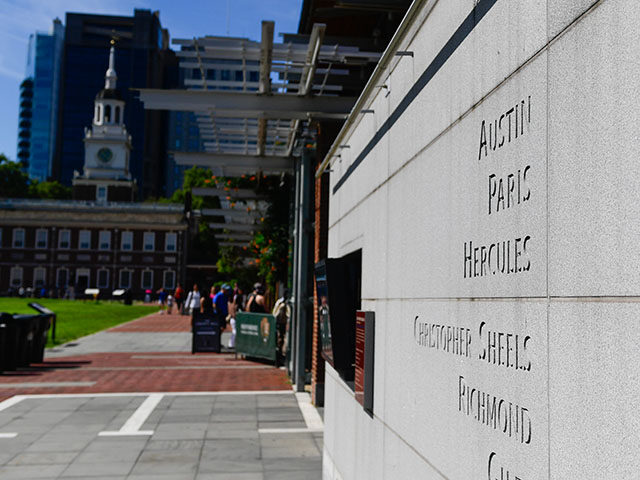

The National Park Service has taken down a slavery exhibit on a site in Philadelphia that marks the home where President George Washington lived when the city served as one of the first capitals of the United States.
The removal of panels at the President’s House Site in the city’s Independence National Historical Park follows President Trump’s directive last March to remove materials that promote “corrosive ideology.”
The outdoor exhibit called “Freedom and Slavery in the Making of a New Nation,” memorialized nine people enslaved by the nation’s first president, according to the group that backed the project.
The National Park Service website says the exhibit “examines the paradox between slavery and freedom in the founding of the nation. Presidents Washington and Adams both lived and worked, along with their households, at a home that once stood on this spot.”
The house, no longer there, has been called the “first White House” before the U.S. capital was established in 1800 when the federal government moved to Washington, DC.
Images of workers removing the panels circulated on social media.
Trump issued an executive order in March of 2025 instructing the Park Service to review materials at national sites to ensure they “focus on the greatness of the achievements and progress of the American people” and do not “inappropriately disparage Americans.”
According to the New York Times coverage of the removal:
The directive specifically flagged Independence National Historical Park for promoting “corrosive ideology.” It claimed the Biden administration had “pressured National Historical Park rangers that their racial identity should dictate how they convey history” and taught visitors that “America is purportedly racist.” The exhibit opened in 2010, during the Obama administration.
In a statement posted on Facebook, activist and criminal defense attorney Michael Coard called the move “historically outrageous and blatantly racist.”
Coard is a founding member of Avenging the Ancestors Coalition, a group of black activists formed in 2002 to advocate for the creation of the slavery memorial at Independence National Historical Park.
According to its website, the memorial was to “honor the nine African descendants enslaved by” Washington, while also pointing out that they were only part of “316 Black men, women, and children enslaved by Washington at his Mt. Vernon, Virginia plantation.”
The Times report pointed out other moves by the National Park Service that detractors will no doubt use as grist to claim the Trump administration as harboring racist motives.
In December, the Park Service was ordered to remove merchandize related to diversity, equity and inclusion from gift shops. It also cut Martin Luther King’s Birthday and Juneteenth, two holidays honoring Black history, from its list of free entrance days to national parks, while still offering free entrance on other national holidays.
The fact some of America’s founding fathers were slave owners has been a favorite saw among those critical of the nation’s founding. However, some historians say the original thirteen colonies could have never united into one if slavery was outlawed, though some wanted it abolished.
As University of Texas historian Steven Mintz wrote:
The framers of the Constitution believed that concessions on slavery were the price for southern delegates’ support for a strong central government. They were convinced that if the Constitution restricted the slave trade, South Carolina and Georgia would refuse to join the Union.
Trump’s order back in March, titled “Restoring Truth and Sanity to American History,” sought to accent the positive aspects of the American experience and put a stop to a “distorted narrative driven by ideology rather than truth.”
Trump wrote, “It is the policy of my Administration to restore Federal sites dedicated to history, including parks and museums, to solemn and uplifting public monuments that remind Americans of our extraordinary heritage, consistent progress toward becoming a more perfect Union, and unmatched record of advancing liberty, prosperity, and human flourishing.”
Lowell Cauffiel is the recipient of Columbia University’s prestigious Paul Tobenkin Memorial Award for his series on racial conflict in Detroit in the 1980s. He’s the best-selling author of Below the Line and nine other crime novels and nonfiction titles. See lowellcauffiel.com for more.
COMMENTS
Please let us know if you're having issues with commenting.