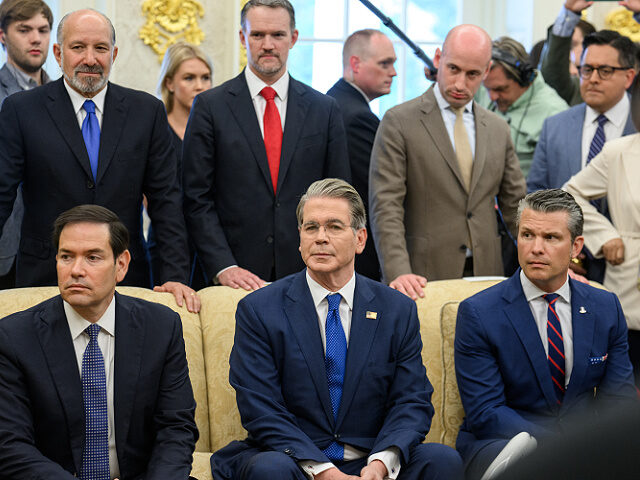

Roughly half a dozen Trump administration officials are now living in military housing in the Washington, DC, area as mounting threats against senior U.S. officials, including Iranian assassination plots, have prompted extraordinary security measures.
CNN reported Friday that a historically high number of civilian administration officials are residing on military installations, including Treasury Secretary Scott Bessent, Secretary of State Marco Rubio, War Secretary Pete Hegseth, White House Chief of Staff Stephen Miller, and Attorney General Todd Blanche.
Bessent, who has spearheaded the Trump administration’s campaign to economically cripple the Iranian regime, is the latest known Cabinet official to relocate to military housing.
As Breitbart News previously reported, the threats against the Treasury secretary had reached what a senior administration official described as “more than an advanced stage.”
Bessent has since publicly addressed the threats, making clear that his relocation came at the direction of the Secret Service and that Tehran’s efforts to intimidate him would not deter the administration from intensifying its economic pressure campaign.
“F the Iranian leadership,” Bessent declared this month, characterizing the threats against his life as evidence that the administration’s Operation Economic Outcast was working.
The Treasury secretary also accused the Wall Street Journal of “reckless journalism” over its publication of photographs of his private residence despite requests that the newspaper refrain from doing so.
The threats against Bessent come amid broader intelligence warnings about Tehran’s efforts to target Americans both at home and abroad.
Earlier this month, U.S. intelligence reportedly indicated that Iran was exploring the use of a radiological “dirty bomb” or chemical weapons to target senior American officials in Washington, though the White House maintained that there were no credible threats to the homeland.
The revelations followed the disclosure of an unclassified intelligence memorandum in late October in which Director of National Intelligence Jay Clayton warned Rubio that Iranian assassination plots against Americans abroad had reached “advanced stages.”
Clayton subsequently warned Congress that Iranian threats against Americans had “substantially increased.”
“Our women and men abroad, our women and men here in the United States, are under greater threat,” he told the House Homeland Security Committee.
While Rubio has stressed that U.S. intelligence has not identified an imminent threat of a dirty-bomb attack in Washington, President Donald Trump has warned that Iran would face devastating consequences if it attacked the United States.
“They will pay a price the likes of which no country has ever paid before,” Trump said.
The heightened security concerns also come as Asif Merchant, a Pakistani national trained by Iran’s Islamic Revolutionary Guard Corps (IRGC), was sentenced last week to 27 and a half years in prison for his role in a thwarted Iranian-directed assassination conspiracy targeting Trump and other American political figures.
Iranian threats, however, are not the only security concerns prompting senior administration officials to relocate.
Blanche also recently moved into military housing over security concerns, CNN reported, citing people familiar with the matter. His predecessor, Pam Bondi, had similarly relocated to a military installation last year.
Miller and his family relocated last year after their private residence became the target of a harassment campaign, amid heightened concerns over political violence following the assassination of Turning Point USA founder Charlie Kirk.
“The Millers relocated because there was an elaborate, well-documented stalking, doxing, and threat campaign targeting their residence,” the White House told the outlet.
The relocations come amid a broader surge in threats against public officials, with U.S. Secret Service Director Sean Curran recently describing the threat environment as the most challenging he has witnessed in his 24-year career.
Senior Secret Service officials told reporters that the agency had handled 10,000 threat-related cases involving its protectees this year, with threats increasing by 40 percent over the previous year.
“The threat picture and environment is as large as I’ve ever seen it,” Curran said.
While the practice of housing civilian Cabinet officials on military installations predates the current Trump administration, the number currently doing so represents a significant departure from previous administrations.
Robert Gates became the first defense secretary to reside in military housing under President George W. Bush. In 2008, the Pentagon argued that housing Gates on a military installation would save taxpayers the cost of establishing and maintaining round-the-clock security at a private residence.
Congress subsequently established a rental arrangement requiring defense secretaries to pay five percent more than a four-star general or admiral.
Rep. George Whitesides (D-CA), meanwhile, secured House Armed Services Committee approval for a Pentagon report, due next spring, examining the security threats behind the relocations, the legal authority for housing political appointees on military installations, and whether the officials are paying fair market rental rates.
A White House official told CNN that while many Cabinet officials are unable to live in the city “due to targeted security threats,” they have personally contributed to the administration’s efforts to make the nation’s capital “safe and beautiful.”
Bessent, meanwhile, has vowed that Tehran’s threats will not deter the administration from pursuing its economic pressure campaign.
“I’m not going to be cowered,” he said. “They have initiated death threats against me and other members of the Cabinet. We’re not going to be cowered.”
Joshua Klein is a reporter for Breitbart News. Email him at jklein@breitbart.com. Follow him on Twitter @JoshuaKlein.
COMMENTS
Please let us know if you're having issues with commenting.