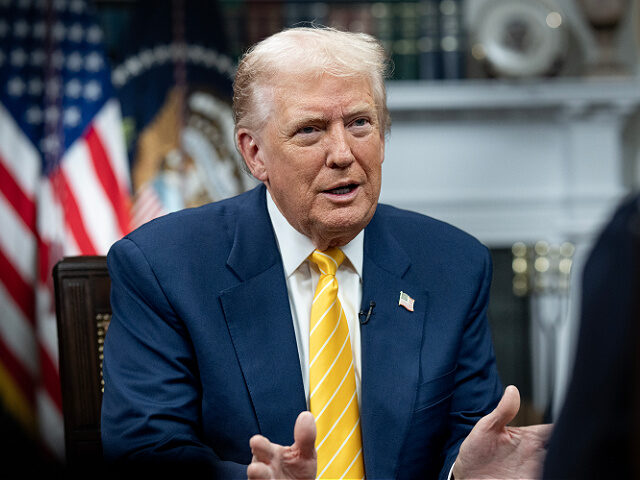

President Donald Trump told American troops during a Thanksgiving call Thursday that victory over Iran was “at hand,” saying his administration was giving Tehran “every chance to make a deal and save a lot of lives” but questioning whether the regime would seize the opportunity.
Speaking from his Mar-a-Lago estate in Florida during a series of holiday calls with U.S. service members deployed overseas, Trump asserted that the United States could bring the conflict to an end whenever he chose.
After wishing Army personnel safety and success in their continued deployment, Trump declared, “We have victory at hand,” adding that it would come “whenever I want it to be, to be honest.”
Despite his confidence in the outcome of the military campaign, Trump emphasized that he was offering the Iranian leadership an opportunity to resolve the conflict diplomatically.
“We’re trying to be nice. We’re giving them every chance to make a deal and save a lot of lives,” he said. “But I’m not sure if they are going to take advantage of that. Some people question why. Are they crazy? Maybe they are.”
During an exchange with Air Force Lt. Col. Brent Smith, whose fighter squadron has been conducting combat operations from Saudi Arabia, Trump pointed to the deterioration of Iran’s military capabilities since the conflict began nearly nine months ago.
Asked by the president whether he was facing “a much tamer enemy,” Smith replied, “Absolutely. I think my assessment is they’re starting to run out of things.”
Trump agreed, noting that American forces had grown stronger with the deployment of an additional aircraft carrier.
“We’re loaded up,” the president said, adding that the Iranians had made numerous mistakes and that their economy was “down the tubes.”
In a separate call with the crew of the USS Portland, Trump praised the sailors for spending more than 150 consecutive days at sea this year helping enforce what he described as “the most successful blockade in naval history.”
“Not one ship has gotten through to Iran,” Trump said, emphasizing the Navy’s role in ensuring that the Islamic Republic would never acquire a nuclear weapon.
Asked by an Air Force service member about the future of American relations in the Middle East, Trump stressed that the United States did not need the region’s oil but had a vital interest in its stability.
“What we do need is we need peace in the Middle East,” Trump said, warning that a nuclear-armed Iran would attack Israel and other countries in the region, resulting in a “nuclear holocaust.”
Trump warned that the regime would also seek to target American cities, noting that Iran already possessed the capability to reach Europe, though not the United States.
“I’ve gotten to know them, and they are crazy, frankly. They’re crazy,” he said. “That’s why we’re not going to let them have a nuclear weapon.”
Speaking to reporters after the calls, Trump reiterated his willingness to give Tehran “a chance to be smart” but warned that the United States remained capable of inflicting further damage on the Islamic Republic.
“Their military is decimated,” Trump said, declaring that Iran’s air force, navy, and air defenses had been wiped out.
Trump said Iran had been unable to resume work at the nuclear facilities previously struck by the United States, identifying Pickaxe Mountain, a heavily fortified underground complex near Iran’s Natanz uranium enrichment facility, as a target should Washington undertake further strikes.
The president suggested there was little need to conceal the potential target, telling reporters, “I mean, we can tell them because they can’t do anything about it.”
“We would absolutely hit Pickaxe Mountain. But we haven’t seen any real activity there,” Trump added.
Trump’s remarks came two days after he revealed in an Oval Office interview with the New York Post that U.S. military operations against Iran were funded through January, while acknowledging that the incoming Democratic-controlled Congress could constrain his ability to pursue further military action.
“I don’t know how they could do that politically, because we have a win. We can put that war to bed anytime we want,” he said.
During the same interview, Trump described Israel’s objective of toppling the Iranian regime as “probably doable,” but stressed that his administration’s priority was eliminating the Iranian nuclear threat rather than pursuing regime change.
“I just don’t want them to have a nuclear weapon. I was never for or against regime change, that was never a criteria for me,” he said.
Trump had previously indicated in an interview with Fox News correspondent Trey Yingst on Sunday that he was inclined to authorize another major military campaign against Iran after the start of the new year if negotiations failed.
While confirming that contacts with Tehran were continuing, Trump dismissed Iranian negotiators as “professional tap dancers,” adding, “They talk all the time. All they do is talk, but it’s all BS.”
While Trump has kept the option of renewed military action on the table, his administration has intensified its economic campaign against the Islamic Republic, unveiling sweeping sanctions Monday targeting Iran’s shadow banking networks, which Treasury Secretary Scott Bessent described as the regime’s “last financial lifeline.”
Bessent announced Wednesday that Iran had exhausted its supplies of oil available for sale at sea.
“The Iranian regime is a sinking ship,” he wrote. “After failing to load a single tanker since Treasury launched Operation Economic Outcast in August, Iran doesn’t have a drop of oil on the water left to sell.”
Iranian President Masoud Pezeshkian himself acknowledged the severity of the economic pressure on Saturday, describing it as more difficult to endure than conventional military attacks.
“We are engaged in a silent war that is far more difficult than one in which missiles are launched and destruction is caused,” Pezeshkian said.
The economic toll has become increasingly apparent, with Iranian authorities rationing electricity and scaling back bread and gasoline subsidies, the Washington Post reported Thursday.
The renewed blockade on Iranian oil exports has deprived Tehran of an estimated $3 billion to $4 billion in monthly revenue, according to the report, compounding the damage inflicted by months of military operations.
Despite the mounting economic strain, Tehran has continued to insist on its negotiating demands, with Iranian Foreign Minister Abbas Araghchi acknowledging Thursday that ongoing mediation efforts by Qatar and Pakistan had yielded new proposals.
“These are under review, but our principled position has not changed,” Araghchi said. “We have a set of demands, and these demands must be implemented.”
Joshua Klein is a reporter for Breitbart News. Email him at jklein@breitbart.com. Follow him on Twitter @JoshuaKlein.
COMMENTS
Please let us know if you're having issues with commenting.