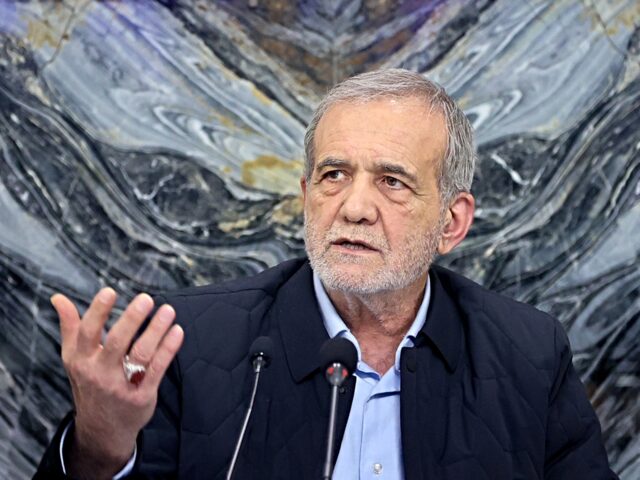

Iranian President Masoud Pezeshkian acknowledged Saturday the economic battle confronting the Islamic Republic is “far more difficult” than one fought with missiles, as President Donald Trump’s sweeping campaign to isolate Tehran tightens its grip on the country’s battered economy.
The admission comes as Washington intensifies Operation Economic Outcast, enforcing a sweeping naval blockade and expanding sanctions against Iran’s oil trade and financial networks, while soaring inflation, worsening energy shortages, and fears of renewed anti-regime unrest compound the country’s economic turmoil.
“We are engaged in a silent war that is far more difficult than one in which missiles are launched and destruction is caused,” Pezeshkian told a capital markets conference in Tehran, according to Iran’s state-run IRNA news agency.
“It is an economic war, one that you, as economic actors, are dealing with, and it is no easy battle,” he continued.
The unusually stark admission laid bare the economic pressures confronting Tehran, even as Pezeshkian insisted the country had resisted efforts by its adversaries to cripple it.
Pezeshkian also warned that worsening natural gas and electricity shortages threaten factory production and jobs as Iran approaches winter.
He urged officials to keep factories running rather than cut industrial power to spare government offices, acknowledging that authorities had previously prioritized residential electricity supplies out of fear that widespread household outages could provoke public anger, according to Iran International.
His warnings follow a recent Reuters report that Iranian officials fear renewed unrest as worsening energy shortages collide with soaring inflation, declining living standards, and the economic pressure of U.S. sanctions and the naval blockade.
Damage to gas-processing infrastructure has compounded Iran’s longstanding energy problems, with officials projecting a domestic gas shortfall of roughly 430 million cubic meters, compared with approximately 300 million previously.
For Tehran, the danger extends beyond lost production and rising prices to the prospect that mounting hardship could reignite demonstrations against the Islamic Republic.
Iranian authorities are preparing to deploy a new artificial intelligence-enabled neighborhood monitoring system through the Basij, the regime’s sprawling paramilitary force used to suppress dissent and enforce internal security, according to an announcement carried by Iran’s state-aligned Tasnim news agency.
The initiative, presented by Iranian authorities as a neighborhood assistance program, would allow Basij personnel to identify influential residents and map local resources, expanding the organization’s reach into communities already facing mounting economic hardship.
The rollout follows reports of renewed anti-regime demonstrations, including a gathering of more than 1,000 protesters in Abdanan earlier in the week, where participants reportedly chanted slogans against the Islamic Republic’s leadership.
The growing economic strain and fears of unrest come as the Trump administration presses its campaign to sever Tehran’s remaining sources of revenue and force the regime toward an agreement without another major military offensive.
On Friday, the Treasury Department imposed new sanctions on Iranian oil intermediaries accused of diverting proceeds from petroleum sales, targeting financial networks that have left Tehran struggling to recover billions of dollars in revenue.
Announcing the measures, Treasury Secretary Scott Bessent said Iran had exhausted the crude oil available aboard vessels outside the American blockade, leaving the regime with dwindling opportunities to generate revenue from overseas sale
“The regime has exhausted its seaborne oil supply, and it may never see the revenue from the oil it has already sold,” Bessent said. “The ship is sinking.”
Appearing on Newsmax later Friday, Bessent hailed the administration’s isolation campaign as “the greatest program in the history of the world to isolate a single country,” declaring, “And it is working.”
CENTCOM said earlier this month that the blockade alone had prevented more than $25 billion in Iranian crude exports.
Washington is extending its campaign beyond the naval blockade, targeting Iran’s overland smuggling routes and sanctions-evasion networks through the recently established Task Force Iron Gate.
The U.S. Central Command initiative aims to disrupt illicit shipments and revenue flows through Iran’s land corridors and the Caspian Sea, tightening restrictions on the regime’s access to foreign markets.
Secretary of State Marco Rubio has argued that the administration’s economic campaign is inflicting such severe damage on Tehran that another major round of military strikes is unnecessary for now.
“The economic pain that is being inflicted on Iran right now and on that regime is extraordinary and it compounds,” Rubio said, emphasizing that the pressure continues to grow.
“There’s no need to disrupt that at this point,” he added.
That strategy was echoed in a Saturday report by Israel Hayom, which cited diplomatic sources saying Trump favors intensifying the economic campaign over launching another broad military offensive.
The effort reportedly includes pressing regional governments to shut down routes used to disguise Iranian oil shipments and circumvent U.S. sanctions.
For Iran’s leadership, the consequences are increasingly difficult to contain: dwindling oil revenue, mounting energy shortages, and growing fears of unrest, even as Washington expands the economic campaign that Pezeshkian himself describes as a battle more difficult than one fought with missiles.
Joshua Klein is a reporter for Breitbart News. Email him at jklein@breitbart.com. Follow him on Twitter @JoshuaKlein.
COMMENTS
Please let us know if you're having issues with commenting.