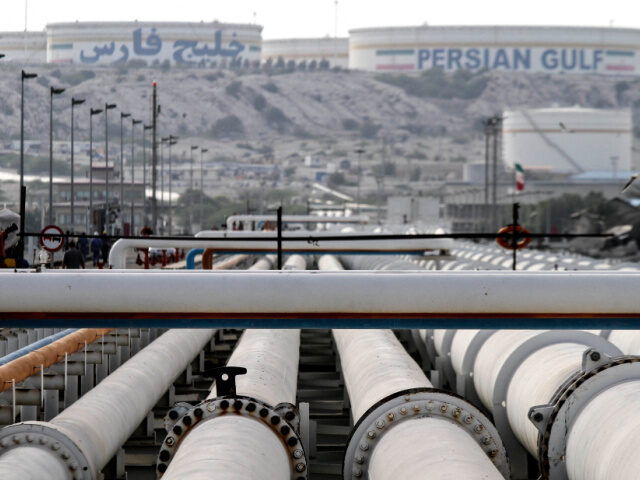

President Donald Trump reportedly favors intensifying the economic campaign against Iran over renewed major military strikes, with Washington seeking to choke off the regime’s remaining oil-export routes as Tehran struggles under the weight of the American blockade.
Trump currently favors expanding the economic campaign among four options presented by his advisers, according to a Saturday report by Israel Hayom citing three diplomatic sources familiar with the deliberations. The strategy reportedly includes pressing Gulf governments to help shut down Iranian oil-smuggling routes through Iraq while maintaining the naval blockade and expanding efforts to protect commercial shipping from Iranian attacks.
The reported preference comes as Trump resists calls for another major offensive, Iranian forces threaten to break the blockade, and diplomatic efforts remain deadlocked over Tehran’s nuclear program and control of the Strait of Hormuz.
The administration weighed four approaches: negotiating an agreement with Tehran, launching another major offensive, conducting limited strikes against Iranian nuclear and military facilities, or intensifying the economic campaign, the report said.
Negotiations have stalled over Tehran’s refusal to accept Washington’s terms, while another major offensive risks triggering widespread Iranian retaliation against American forces and Gulf infrastructure without guaranteeing a decisive result, according to the report. Limited strikes remain under consideration, but Trump reportedly favors tightening the economic squeeze, with support from Secretary of State Marco Rubio, Treasury Secretary Scott Bessent, and Commerce Secretary Howard Lutnick.
Trump has repeatedly signaled his reluctance to resume major strikes, previously describing another offensive as “highly unlikely” and more recently indicating that he is in no rush to make a decision. Rubio has likewise argued that Washington is achieving its objectives through economic pressure without another major military campaign.
The administration had already begun extending its interdiction efforts beyond Iranian ports, with CENTCOM announcing Task Force Iron Gate two weeks ago to disrupt illicit revenue, weapons shipments, and sanctioned materials moving across Iran’s land borders and the Caspian Sea.
The latest effort reportedly focuses on Iranian crude moving through Iraq, where shipments are disguised as Iraqi or Kurdish oil before being routed toward ports in Syria or Turkey. Washington is pressing Gulf governments to help shut down the trade, and regional leaders have reportedly pledged to pressure Baghdad to cooperate, according to the Israeli report.
CENTCOM marked 130 consecutive days of the naval blockade Saturday, crediting American forces with preventing the IRGC from exporting billions of dollars in crude oil. The command previously estimated that the blockade had prevented more than $25 billion in Iranian crude exports.
The financial squeeze intensified Friday when the Treasury Department sanctioned four Iranian oil trustees accused of handling proceeds from the regime’s crude sales, including intermediaries who allegedly pocketed money intended for Tehran. The sanctions are part of Operation Economic Outcast, the broader campaign launched in August to cut off the regime’s remaining financial lifelines.
Treasury said Iran had not loaded oil onto vessels since the campaign began and had no crude aboard ships outside the American blockade, leaving Tehran scrambling to recover billions of dollars from oil already sold.
Bessent, who reportedly relocated to a military installation after Iranian death threats against him reached an advanced stage, warned during a Friday evening Newsmax interview that mounting economic pressure could soon trigger infighting within Tehran’s leadership.
“I regard the bounty that they have on my head as a sign of success,” Bessent said.
“My guess is they will soon start turning on each other,” he predicted. “They may start lashing out in terms of some indiscriminate shooting in the Middle East, but they are wounded, cornered animals.”
Bessent said the campaign could ultimately bring Tehran to the negotiating table or deepen divisions within the IRGC.
Iran’s own president has acknowledged the worsening economic crisis, including severe energy shortages threatening industrial production.
Iranian President Masoud Pezeshkian described the country’s predicament Saturday as a “silent economic war,” warning that its effects could prove more difficult to endure than the destruction caused by missile strikes.
Pezeshkian acknowledged that gas shortages predated attacks on Iranian facilities and urged officials to shield factories from electricity cuts, warning that further disruptions could threaten jobs and deepen the economic crisis.
Rather than soften its negotiating demands, Tehran has threatened to confront the American blockade directly.
Iranian Deputy Foreign Minister Kazem Gharibabadi warned Saturday that Tehran would take whatever measures it considered necessary to break the blockade, which he characterized as an act of war.
“We will take whatever measures necessary to break it,” he declared, according to Iranian state broadcaster Press TV.
The warning comes as more than a dozen Iranian oil tankers have reportedly gathered near Kharg Island, the country’s principal crude-export terminal, amid discussions in Iranian media of a convoy intended to challenge the blockade.
Iranian sources have also threatened attacks on energy infrastructure in neighboring Gulf states if American forces intercept the vessels. The proposed convoy has not been confirmed to have departed, and there is no verified indication that it has breached the blockade.
The warnings come amid another round of attacks on Gulf shipping and infrastructure, underscoring the risks of escalation as Washington tightens its economic campaign.
Two commercial tankers were struck by projectiles near the Strait of Hormuz Saturday, with one reporting damage to its stern and another to its engine room, according to the United Kingdom Maritime Trade Operations agency. No casualties were reported.
Bahrain also reported an Iranian attack on a civilian industrial facility Saturday that sparked a fire and caused material damage but no casualties. The IRGC separately claimed strikes against American air-defense radar systems at Al-Riffa and Awali.
The latest claims follow earlier Iranian assertions that its drones struck American radar installations in Bahrain last Friday and again Tuesday. Although Tehran has repeatedly claimed to have damaged American military equipment, those claims remain unverified, with a U.S. official reporting no damage to American forces or military assets in the latest attacks.
Tehran has also sought to project military strength despite the damage inflicted on its forces during American and Israeli operations.
On Saturday, IRGC commander Ahmad Vahidi toured an underground missile facility showcased by Iranian state media, where commanders displayed a purported dual-missile launcher and threatened further retaliation against their adversaries.
Gulf governments, meanwhile, are seeking stronger protection for oil facilities, gas infrastructure, and desalination plants amid Iranian attacks, including expanded defensive coordination with Israel, according to the Israeli report. Regional leaders have also expressed concern that another major American offensive could expose their countries to further Iranian retaliation.
Even as the military confrontation intensifies, diplomatic channels remain open, though Tehran has shown little willingness to retreat from the demands Washington has rejected.
Special Envoy Steve Witkoff and Jared Kushner met Qatari mediators in Berlin Thursday, followed by a Qatari delegation’s visit to Tehran Friday. The discussions produced no announced breakthrough.
Iranian Foreign Minister Abbas Araghchi insisted Saturday that Tehran would not reopen the Strait of Hormuz until Washington accepted its conditions, including lifting the American blockade.
“There is no solution to the current situation unless the US acknowledges its mistakes and fulfills its previous commitments,” Araghchi declared, according to Press TV.
Gharibabadi separately claimed Iran could reopen the waterway within hours if Washington lifted the blockade and released frozen Iranian funds. He also ruled out transferring Tehran’s enriched uranium stockpile abroad under a potential agreement.
Those demands remain incompatible with Trump’s insistence on a lasting agreement that permanently prevents Iran from acquiring nuclear weapons.
Speaking to reporters Friday, Trump accused Tehran of seeking another agreement that would leave its nuclear ambitions unresolved.
“They want to make a deal, but they don’t want to make a deal that’s acceptable to me,” Trump said. “We want to make a real deal, not a fake deal that they’ve been doing for 51 years.”
“They’ve been bullshitting people for 51 years,” he added.
Trump sharpened that demand Saturday, telling Fox News that any agreement must endure beyond his presidency and prevent future administrations from allowing Iran to acquire nuclear weapons.
“I’m going to make a deal that is going to be permanent,” he said. “I’m not going to let somebody allow them to have a nuclear weapon.”
Trump’s reported preference leaves the threat of renewed military strikes on the table while seeking to deprive Tehran of the oil revenues sustaining its regime — a strategy aimed at forcing an agreement that Iranian leaders continue to resist, even as they threaten to break the blockade by force.
Joshua Klein is a reporter for Breitbart News. Email him at jklein@breitbart.com. Follow him on Twitter @JoshuaKlein.
COMMENTS
Please let us know if you're having issues with commenting.