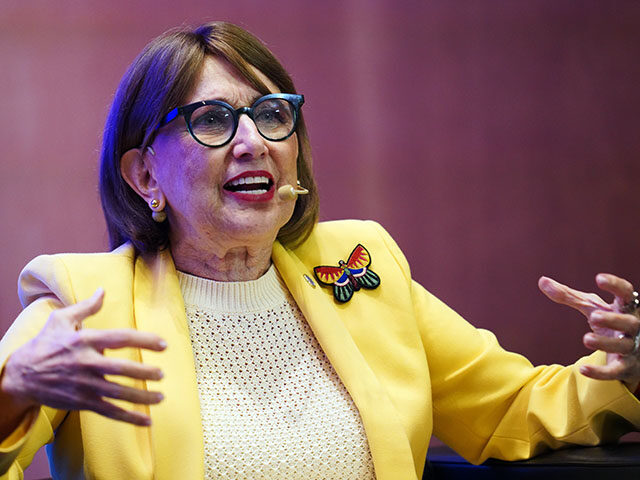

- A Security Council poll on Friday found Costa Rican economist Rebeca Grynspan as the frontrunner in the U.N. secretary-general race, but facing multiple vetoes from permanent members of the Council.
- No candidate in the race has avoided permanent member veto, meaning the body has not formed a consensus with little more than a month to the end of the current U.N. chief’s term.
- The U.N. has no rules on what to do if an incumbent secretary-general’s term ends without a successor.
A semi-anonymous poll in the Security Council for the new secretary-general of the United Nations on Friday yielded no clear frontrunner in the race with little more than a month to go before Secretary-General Antonio Guterres’s term expires.
Guterres is set to vacate the most powerful position in the United Nations on December 31. Eight candidates are vying to replace him, but all top three candidates, according to the latest poll, face potential vetoes from Security Council permanent members. The process to choose a secretary-general is traditionally opaque and confusing from the outside, fueled by backroom campaigning and guided by mostly anonymous straw polls before the Security Council chooses to nominate a candidate before the General Assembly. If a candidate receives enough support in the Security Council and no vetoes to reach the General Assembly, they are typically expected to be elected to the role.
Prior to the official vote, the Security Council holds straw polls to gauge interest in each candidate. The voting asks Security Council members to assess each candidate, offering either a vote “encouraging” them to stay in the race or “discouraging” them. A “discouraging” vote from a permanent member of the Security Council suggests that that member would veto the candidacy and prevent the candidate from being nominated to the General Assembly. All three top candidates received at least two “discouraging” votes from permanent members. The process does not allow for knowing the specific votes of each of the five: America, Russia, China, France, and the United Kingdom.
Eight candidates are officially vying for the secretary-general position in this race. The frontrunner after Friday remains Rebeca Grynspan, a former vice president of Costa Rica and career economist that some reports have called a “continuity candidate” that would follow Guterres’s template. Guterres’s tenure has been catastrophic for the United Nations, as it has been sidelined out of relevance in nearly every major global conflict and seen its funding crater after the World Health Organization (W.H.O.)’s woeful handling of the Wuhan coronavirus pandemic.
Grynspan received the highest number of “encourage” votes, at ten, but two “discouraging” votes from permanent members, according to a report from the Emirati newspaper The National. Notably, her support dropped from 12 to ten “encourage” votes. Rafael Grossi, the U.S.-friendly head of the International Atomic Energy Agency (IAEA), came in second place, but received three “discouraging” votes from veto-wielding powers. In third, Emirati candidate Lana Nusseibeh received the same number of “discourage” votes as Grossi but one fewer “encourage” votes.
The vote on Friday was the ninth of its kind and some observers were hoping it would lend clarity to the possibility of a candidate acceptable to all five permanent members. Prior to the vote, Reuters reported on Thursday that United Nations officials are concerned enough that no consensus will be formed by December that they are considering how to proceed without an agreed-upon successor to Guterres in 2027. The United Nations has no fixed rules on what to do if the body has not chosen a new secretary-general by the end of the incumbent’s term.
“Officials are scrambling to draft contingency plans in case no one is at the helm when Guterres steps down on December 31,” Reuters observed. “The UN Charter is silent on how to handle a leadership vacancy. A secretary-general has never ended their term without a replacement.”
Adding to the discord is the fact that Guterres himself does not seem to be especially backing any particular candidate and that, as a result of the poor legacy he is leaving, “critics say Guterres lacks that influence, having fallen out with both Washington and Moscow.”
America’s ambassador to the United Nations, Mike Waltz, addressed the situation on Friday, stating that America is seeking to back the best candidate and is looking for someone open to rebuilding what remains of the global institution after Guterres.
“We need a leader that can lead this institution, that can reform this institution, and that can be a major player on the world stage in bringing peace and security,” he asserted.
Ambassador Waltz also suggested that some of the candidates ranking lower in the straw polls repeatedly should consider ending their candidacies.
“If they haven’t received it [support], we think it’s probably time to step aside and let the council consider a narrower field,” he said.
COMMENTS
Please let us know if you're having issues with commenting.