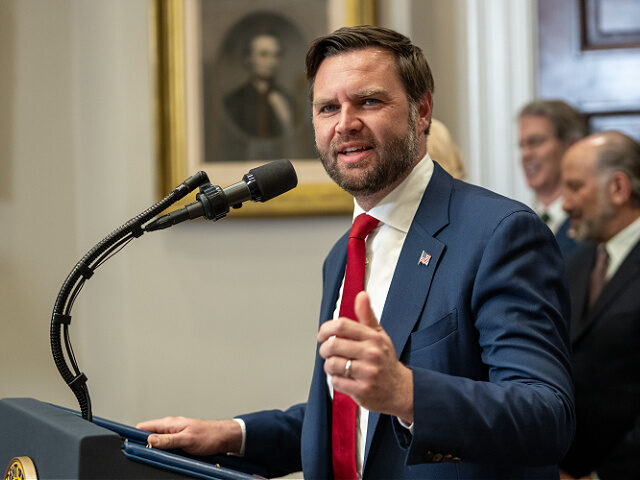

Vice President JD Vance said the U.S.-Iran conflict will enter a “much different phase” within months, declaring the first stage of the campaign complete as Washington moves to prevent Tehran from rebuilding its nuclear and military capabilities.
“There are really two phases to this thing, and the first phase is done,” Vance told the New York Post in an interview aboard Air Force Two.
“The first phase was destroy the nuclear program, destroy their conventional military, destroy their ability to project power in a way that they were able to even a couple of years ago,” he said.
The second phase, Vance explained, is to “ensure that they’re not able to rebuild and try to maintain as much global stability in the wake of that.”
The vice president said the transition could become increasingly apparent in the coming months, broadly agreeing with President Donald Trump’s recent prediction that the conflict could wind down following the November midterm elections.
“We can’t predict the future, but I think the president is right to say that this thing will enter a much different phase in a couple of months,” Vance said. “He’s also the commander in chief, so he’s the person who determines … when conflicts start and when they stop.”
Vance’s description sharpens the strategy he outlined less than two weeks ago, when he declared Iran’s control over the Strait of Hormuz “effectively gone” but refused to set an artificial timeline for ending the confrontation as Tehran continued targeting commercial shipping.
At the time, Vance described Iran as “losing their capabilities by the day” as U.S. forces cleared mines, protected commercial vessels and repeatedly struck systems Tehran attempted to restore around the strategic waterway.
Those gains have continued. Vance said commercial traffic through Hormuz has now returned to “well over 50 percent of normal traffic,” while U.S. forces continue enforcing the blockade against Iran and protecting vessels moving through the Strait.
U.S. Central Command said Tuesday that American forces have now redirected 103 commercial vessels to ensure compliance with the blockade, up from 87 when Vance spoke at the White House less than two weeks ago.
The expanding traffic has increasingly separated Tehran’s ability to disrupt the Strait from its ability to use it as leverage. American forces have kept oil and other commercial traffic moving for Gulf states while blocking Iranian exports and responding militarily when Tehran attempts to restore mine-laying and other capabilities around the waterway.
Vance acknowledged continuing Iranian attacks but characterized the current confrontation as markedly different from the major combat operations that dominated the first phase.
“I certainly understand there’s some impatience from the American people, but fundamentally what’s happening right now is that the United States is not engaged in aggressive operations. We’re just not,” he said.
“But what is happening is that the Iranians are occasionally shooting at commercial shipping, usually not successfully.”
That threat was underscored again this week when Iranian boats attempted to seize a U.S. unmanned surface vessel operating in the Strait. CENTCOM spokesman Capt. Tim Hawkins said American forces “forcefully responded” and that the vessel remained under U.S. operational control.
Preventing Iran from rebuilding has also become an explicit objective of the administration’s economic campaign.
Treasury Secretary Scott Bessent told lawmakers Tuesday that the strength of the U.S. economy has allowed Washington to wage what he called “the greatest economic isolation campaign in the history of the world against the Islamic Republic of Iran and its enablers” as Treasury expands Operation Economic Outcast.
“President Trump has taken action that his predecessors have long deferred against a regime that devotes itself to ‘Death to America’ and seeks nuclear weapons to do just that,” Bessent said in testimony before the House Financial Services Committee.
“Under his leadership, America is no longer managing the Iranian threat. We are ending it,” he added.
Bessent also said Washington has held positive private discussions with Beijing over its financial links to Tehran and expects those discussions to continue as the administration presses countries to further isolate Iran economically.
Secretary of State Marco Rubio separately reinforced the administration’s broader objectives during a call Tuesday with Omani Foreign Minister Badr al-Busaidi, condemning recent Iranian attacks on commercial shipping and regional countries while reiterating Washington’s commitment to preventing Iran from obtaining a nuclear weapon and maintaining freedom of navigation through Hormuz.
Trump has meanwhile suggested the mounting military and economic pressure could ultimately bring Tehran back to the negotiating table.
“The failing Nation of Iran wants to make a deal, quickly and badly,” Trump wrote Monday, adding that he would determine whether the United States chooses to engage and that Washington remains open to the possibility.
Vance, who helped negotiate the short-lived June ceasefire and memorandum of understanding with Tehran, stopped short of predicting precisely how the confrontation would end.
Instead, the next phase Vance described brings the administration’s military, maritime, and economic campaigns under a single objective: denying Tehran the opportunity and resources to rebuild the nuclear, conventional military, and power-projection capabilities destroyed during the first phase.
“And then the second phase of this is ensure that they’re not able to rebuild and try to maintain as much global stability in the wake of that,” Vance said.
Joshua Klein is a reporter for Breitbart News. Email him at jklein@breitbart.com. Follow him on Twitter @JoshuaKlein.
COMMENTS
Please let us know if you're having issues with commenting.