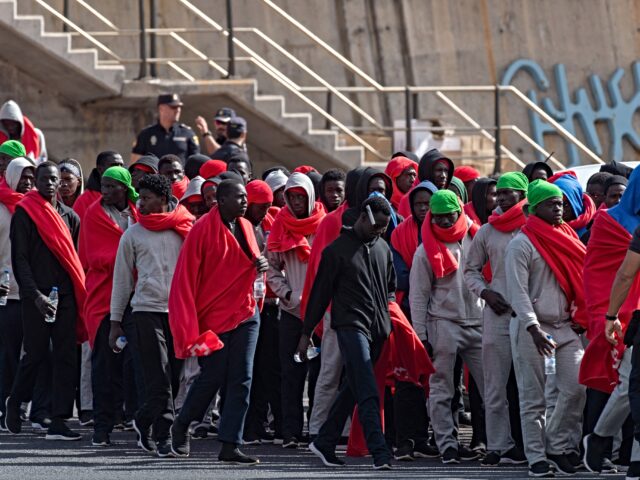

The local government of the Spanish Canary Islands declared a state of sanitary, social, and security emergency Wednesday while pleading for help after the shocking arrival of thousands of illegal migrants at the tourist hotspot in recent days.
Spain is going through a new migrant crisis following the arrival of thousands of mostly African migrants at the Canary Islands, a highly popular Atlantic tourist spot.
The crisis has majorly affected El Hierro, a smaller Canary island with about 12,000 inhabitants. The situation further worsened on Tuesday, November 24, when upwards of 2,100 migrants arrived across several boats throughout the course of that day, breaking highest single-day figures.
By Wednesday, November 25, upwards of 400 more migrants reportedly arrived at El Hierro across four Cayucos, a local term for the kind of shanty boats that the migrants have been using to arrive at the Canaries.
According to Spanish outlets, over 15,000 illegal migrants have arrived to El Hierro throughout November, an amount much higher than the island’s population.
At press time, the crisis has so far twice broken over 30 year-old records in migrant arrivals at the Canaries.
In response to the ongoing and dramatic crisis, which has significantly strained El Hierro’s resources and infrastructure while also pressuring the rest of the islands, the autonomous movement of the Canary Islands declared the state of emergency and the immediate activation of its PLATECA civil protection territorial emergency plan.
“Not surprisingly, the massive and ongoing influx of migrants arriving by sea on the island of El Hierro is currently creating an exceptional situation that may require the reinforcement of health, social, and security measures, as well as services to assist the population, according to the bulletin signed by Manuel Miranda, the regional minister for Territorial Policy, Territorial Cohesion, and Water Resources,” a statement from the Canary Islands government read in part.
The head of the islands government, Fernando Clavijo, warned through a social media post that the islands “can take no more.”
“We are experiencing unprecedented migration pressure in the 32 years of the Atlantic Route,” he wrote.
Clavijo also detailed that he requested an urgent meeting with European Commission President Ursula von der Leyen and is demanding an “immediate response from the E.U.”
“These people are arriving in Europe, and it is not fair for us to respond alone to a crisis of this magnitude,” he added.
Clavijo also requested the urgent deployment of members of the Spanish Armed Forces’ Military Emergencies Unit (UME) to the Canaries to help manage the developing crisis. The Canaries government President confirmed that he requested the Armed Forces deployment to Defense Minister Margarita Robles.
Per the Spanish public broadcaster RTVE, the Ministry accepted the request, and UME troops are expected to arrive at the Canaries throughout Thursday, November 26.
Socialist Prime Minister Pedro Sánchez affirmed on Wednesday that he is “working” with Senegal and The Gambia to “stop the situation,” RTVE states. The Prime Minister also reportedly expressed confidence that the number of arrivals can be reduced in “the coming days.”
Speaking with El Español on Thursday, Clavijo criticized Sánchez for claiming that “immigration was under control,” and stressed that the Prime Minister’s words should be “contrasted with the reality that the rest of us citizens are experiencing.”
“This is the reality of immigration, not what Sánchez says,” Clavijo lamented to El Español.
The Canaries’ President reportedly explained that, in accordance to Spanish laws, his administration declared a “Level 2” emergency and not a higher “Level 3” one.
A “Level 2” emergency, Clavijo said, allows the local government to stay in charge of the handling of the crisis while still being able to request resources from the central government, such as the deployment of UME officials that are expected to arrive on Thursday.
A “Level 3” declaration, Clavijo further detailed to the outlet, would instead place the central government in charge of the crisis’ handling and leave the Canaries’ local government out of the leadership and coordination aspects of the emergency. Unnamed sources affirmed to El Español that Clavijo’s administration does not plan to declare a Level 3 emergency “under any circumstances.”
COMMENTS
Please let us know if you're having issues with commenting.