

Upwards of 2,100 migrants arrived at the Spanish Canary Islands’ El Hierro over the past 24 hours in what Spanish outlets describe as the highest single-day figure at the popular Atlantic tourist hotspot.
The ongoing migrant crisis at the Canary Islands has dramatically impacted the Spanish islands over the past weeks — especially, El Hierro, one of the smallest of the Canaries, with just about 12,000 residents. Throughout November, roughly 12,000 migrants aboard shanty canoes locally referred to as “Cayucos” have arrived at el Hierro, effectively doubling the island’s population and easily overwhelming its port and infrastructure.
The crisis, which had already shattered three decades-old records earlier this month, broke new records again as more migrants arrived throughout Tuesday, November 24.
The Spanish public broadcaster RTVE reports that 2,121 illegal migrants arrived at El Hierro across 15 vessels on Tuesday — among which a deceased individual and a four-day old baby girl reportedly “born at sea” were found by Spanish maritime rescue service officials.
RTVE, citing information collected by the news service EFE, detailed that the newly-arrived migrants allegedly hail from seven different African nations — The Gambia, Senegal, Guinea-Conakry, Guinea-Bissau, Burkina Faso, Mauritania, and Mali, in addition to a single Yemeni national, as documented by local emergency services.
EFE stated that at least 203 of the over 2,100 new migrant arrivals are women, and 127 minors, including a “four month-old” baby and the recently-born baby girl. The migrants reportedly alleged that the vessels departed from The Gambia roughly seven days ago.
Before Tuesday’s arrivals, RTVE pointed out, the previous highest record was documented on Saturday, November 14, with 1,580 migrants arriving at the Canary Islands on that day, 1,327 of which arrived at El Hierro. Nearly 2,200 migrants ended up arriving at the Canaries on that same weekend.
Much like this month’s past mass migrant arrivals, the over 2,100 migrants rapidly overcrowded the La Restring pier as they waited to be transferred. RTVE stated that buses “raced against the clock” to transport the migrants to one of three locations — a local sports center, a CATE temporary migrant reception facility, and a monastery in El Hierro’s La Frontera municipality. The Spanish public broadcaster emphasized that the centers are “overwhelmed and are operating beyond their capacity.”
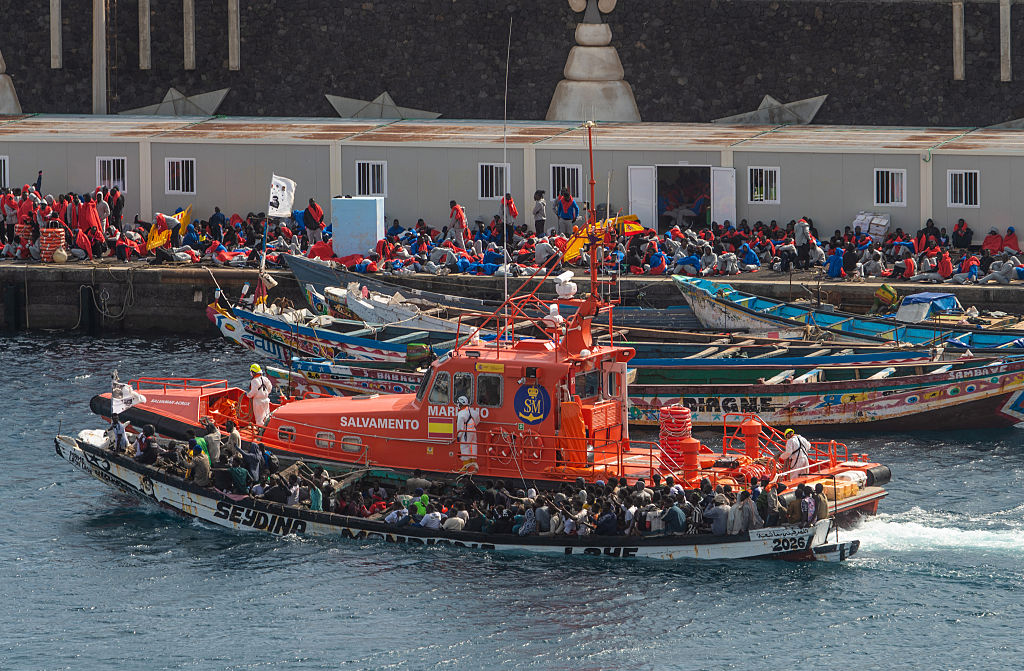
Illegal migrants are seen on the pier as a Spanish Salvamento Maritimo (Sea Search and Rescue agency) vessel tows a ‘cayuco’ boat, one of the nine cayucos that arrived throughout the day, at La Restinga harbor on the Canary island of El Hierro, on November 24, 2026. (Antonio Sempere / AFP via Getty)
Both local and central government authorities have affirmed that the majority of the thousands of migrants have been transferred to other Canary Islands and to mainland Spain throughout November. The President of the Canady Islands’s government, Fernando Clavijo, reportedly detailed that some 370 of the newly-arrived migrants had already been transferred to Tenerife on Tuesday, with the expectation that over 800 more will be transferred throughout Wednesday.
Clavijo also criticized the Spanish central government, and stressed that it is not achieving the “desired effect” through its labor. Per RTVE, the Canary Islands President reportedly emphasized the importance of working with the countries of origin of the migrants to find solutions to the crisis.
“We do not know whether it is due to a lack of cooperation from the authorities in Gambia and Senegal or to some complexity in foreign relations or within the European Union itself, but our request to step up diplomatic efforts and the E.U.’s own involvement in the countries of origin is not yielding the desired results,” the official reportedly said.
The Spanish public broadcaster attributed the ongoing mass migratory flow to “favorable navigation conditions,” which Clavijo noted, is expected to last until December.
In addition to Tuesday’s staggering events, unnamed sources from the Spanish maritime rescue service detailed to RTVE that six Cayuco vessels had arrived on Monday with 812 more migrants — of which only 73 were women, and 48 were minors.
Last week, the leader of the Spanish anti-mass migration party VOX Santiago Abascal condemned the ongoing arrivals as a “planned invasion,” attributing the still-ongoing mass arrivals to the lax, pro-migrant policies maintained by the current socialist government led by Prime Minister Pedro Sánchez.
Before the dramatic and developing events of the migrant arrivals at the Canary Islands in November 2026, the previous record-holder was November 7, 2020, when 1,461 migrants arrived at the Gran Canaria island’s town of Arguineguín, the epicenter of that year’s migrant crisis.
COMMENTS
Please let us know if you're having issues with commenting.