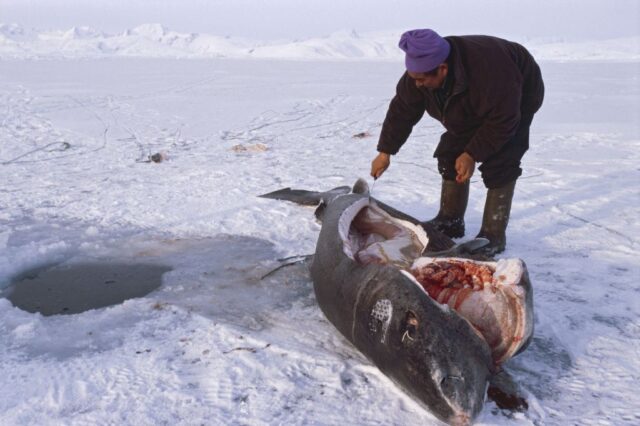

Greenland fishermen are keen to cull upwards of 1,000 local sharks which can live over 400 years, making them the longest-living vertebrates on Earth, as one government instrumentality is offering the financial incentive of $45 per heart for every carcass delivered.
Not everyone is behind the scheme to cut short the long, slow, ice-cold life of Greenland sharks.
Local authorities in the Danish overseas territory have banned the slaughter – for now – with conservationists and marine scientists reacting to the bounty proposal with deep concern, saying that culling could decimate the species.
The conflict arises because Greenland sharks, the second-largest carnivorous species after the great white, feed on the exact same catch that unpins the country’s commercial fishing market.
Fishermen would rather they are gone and are keen to act because as the 20-foot sharks attempt to eat the hooked fish, they get tangled in the lines, tearing apart the expensive equipment and escaping with thousands of hooks.
“This year I’ve lost around 6,000 hooks in total. Sometimes we lose 30,000 Danish krone a day,” 27-year-old fisherman Henrik Jensen told the Guardian.
“We need to safeguard the income of fishers and the catch so that we can continue to eat the foods that we have relied on for generations,” said local mayor Lars Erik Gabrielsen, the NY Post reports.
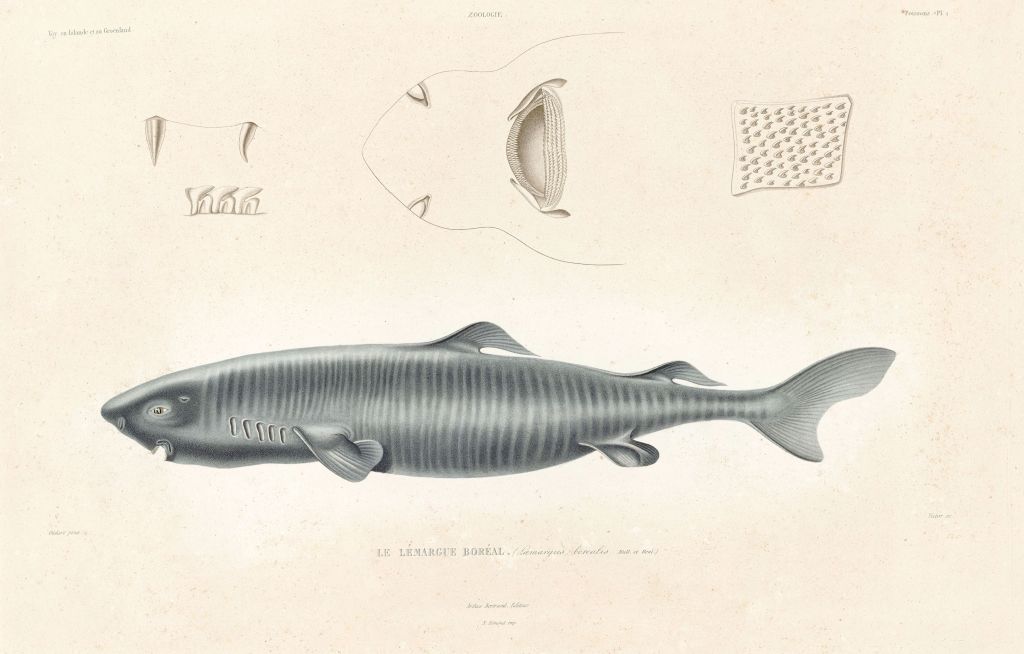
FILE/Plate showing the giant Northern lemargus (lamargus borealis) or Greenland shark. Book “Voyage en Islande et au Groenland” by Louis-Eugene Robert. Illustrated by Antoine Maurin and published in 1835-1836. (Photo12/Universal Images Group via Getty)
The measure remains blocked by critics who fear it would do irreversible damage to the extremely unique shark, which becomes sexually mature at the old age of 150 and is believed to gestate its young for over a decade — meaning populations can take an extremely long time to recover.
“Greenland sharks are extremely long-lived, highly migratory, and important predators in the Arctic and deep North Atlantic,” Dr Julius Nielsen, a Greenland shark expert, said in a statement.
He has studied sharks in Greenland for more than a decade.
“Initiating a bounty system of this magnitude is a risky path – especially if this type of management spreads to other Arctic regions, as it could have an impact on a population which is likely still recovering from the big commercial harvest in the last century.”
Nielsen maintains any regulation should be based on scientific advice.
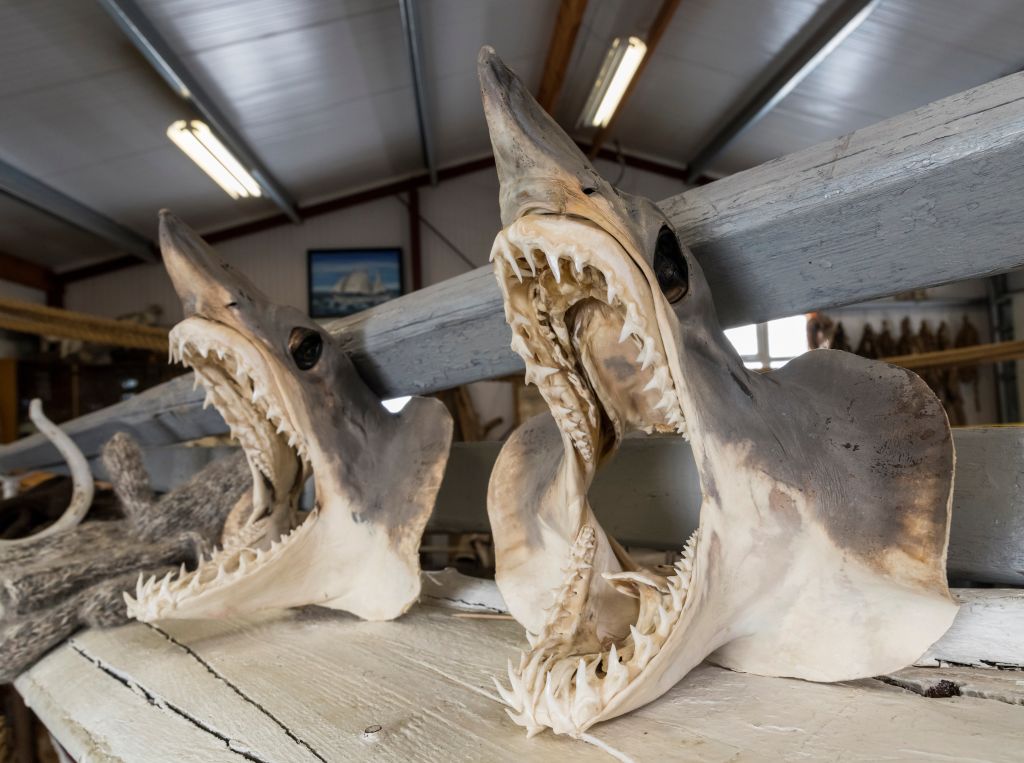
Bjarnarhoefn. a local museum dealing with the iconic local speciality Hakarl. fermented meat of the Greenland shark (Somniosus microcephalus). a protected species and the life on Snaefellsnes. (Martin Zwick/REDA/Universal Images Group via Getty Images)
Greenland sharks were listed as a “vulnerable” species in 2020 by the International Union for Conservation of Nature, PEOPLE reported.
The sharks largely live in the cold coastal waters around Greenland, northern Canada and Europe, and can travel about 1,240 miles per year, the NY Post report states.
A Greenland shark alive today may have been born in the 1750s, early in Danish colonization — or even the 1620s, early in the Little Ice Age.
COMMENTS
Please let us know if you're having issues with commenting.