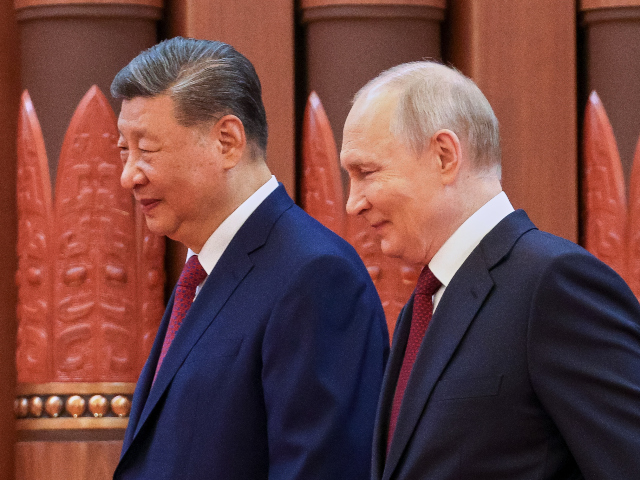

The Chinese Foreign Ministry confirmed on Monday that genocidal communist dictator Xi Jinping has scheduled a trilateral meeting with Russian strongman Vladimir Putin and American President Donald Trump for Thursday, celebrating the unprecedented nature of such an encounter.
Foreign Ministry spokeswoman Mao Ning described the planned meeting as “groundbreaking,” offering minimal details on where the conversation is expected to be headed but expressing optimism that the conference will yield significant positive results for the world. The three heads of state will be in Shenzhen, China, this week to attend the annual summit of the Asia-Pacific Economic Cooperation (APEC) organization and are expected to meet on the sidelines of that event.
“This will be the first ever face-to-face meeting between the Chinese, Russian, and U.S. heads of state,” Mao explained. “The three presidents will have an in-depth exchange of views on safeguarding world peace and enabling strategic stability in major-country relations. The summit is of groundbreaking significance.”
Mao stated that the world’s “current circumstances” make coordination between Russia, China, and America especially important and that the countries should “shoulder important responsibilities to work together in addressing global challenges and promoting world peace and stability.”
“It is in the interest of the three countries to strengthen communication, manage differences, and maintain stable relations,” she added.
Omitted from the Foreign Ministry’s assessment of the meeting are the significant distrust and diverging interests of the three states. As a communist entity, China’s government is heavily invested in spreading anti-American ideology around the world and diminishing American influence. Beijing has also conspicuously avoided relying on Russia for its fuel needs or overly empowering Moscow, even while claiming that the bilateral relationship is better than ever. Russia and America are engaged in a proxy war in Ukraine, where America supports the invaded country, and in Iran, where Russia remains the Iranian regime’s most vocal ally, aiding its nuclear development and joining it for military exercises.
Mao offered only that the leaders would “have an in-depth exchange of views on important issues bearing on global peace.”
“We will release information about the summit in a timely manner,” she promised.
Unnamed American officials told ABC News on Friday that President Trump anticipates being able to raise the issue of nuclear arms reduction during the meeting. The president has made incorporating China into what were once joint American-Soviet nuclear weapons agreements a priority since his first term, insisting that China, as home to the world’s third-largest known nuclear arsenal, must be incorporated into such deals for them to carry any weight. China has aggressively rejected the proposition for years. The added pressure of Putin’s presence at the meeting, however, may positively change the dynamic of the conversation.
The ongoing Iran-American war is also expected to be a topic of discussion, as well as conflicts in the Middle East more generally. The Chinese government recently deployed its Special Envoy Zhai Jun to tour the Middle East, traveling to Iran, Oman, and Saudi Arabia to help elevate China’s status as a relevant player in the conflicts throughout the region. Mao told reporters on Monday that Zhai informed these countries China would work “actively to promote peace and facilitate talks.”
“The most pressing task at hand, they believe, is to rebuild trust as soon as possible, bring the temperature down, and prevent a resumption of fighting,” she claimed.
China is among the economies most affected by Iranian terrorism in the region, including attacks on Saudi Arabia by the Iranian proxy Houthi terrorists of Yemen, as it is the single largest state buyer of Middle East oil. The conflict has caused a visible rift between Iran and China, once close allies, as Xi’s regime has repeatedly demanded that Iran stop interrupting free commerce in the Strait of Hormuz.
China’s enthusiasm for the meeting matched the messages out of the Kremlin on Monday.
“The significance and symbolism of this meeting cannot be overstated,” Yury Ushakov, one of Putin’s top foreign policy officials, told reporters. “It is the first such meeting of its kind. It has been agreed that it should be structured in the spirit of the mutual understanding and alliance between our three countries during World War II, with an emphasis on our countries’ cooperation in the establishment of the United Nations.”
Ushakov also offered few details on the topics expected to be on the agenda, however, stating only that the conversation will have a “significant impact on the development of the international situation as a whole.”
COMMENTS
Please let us know if you're having issues with commenting.